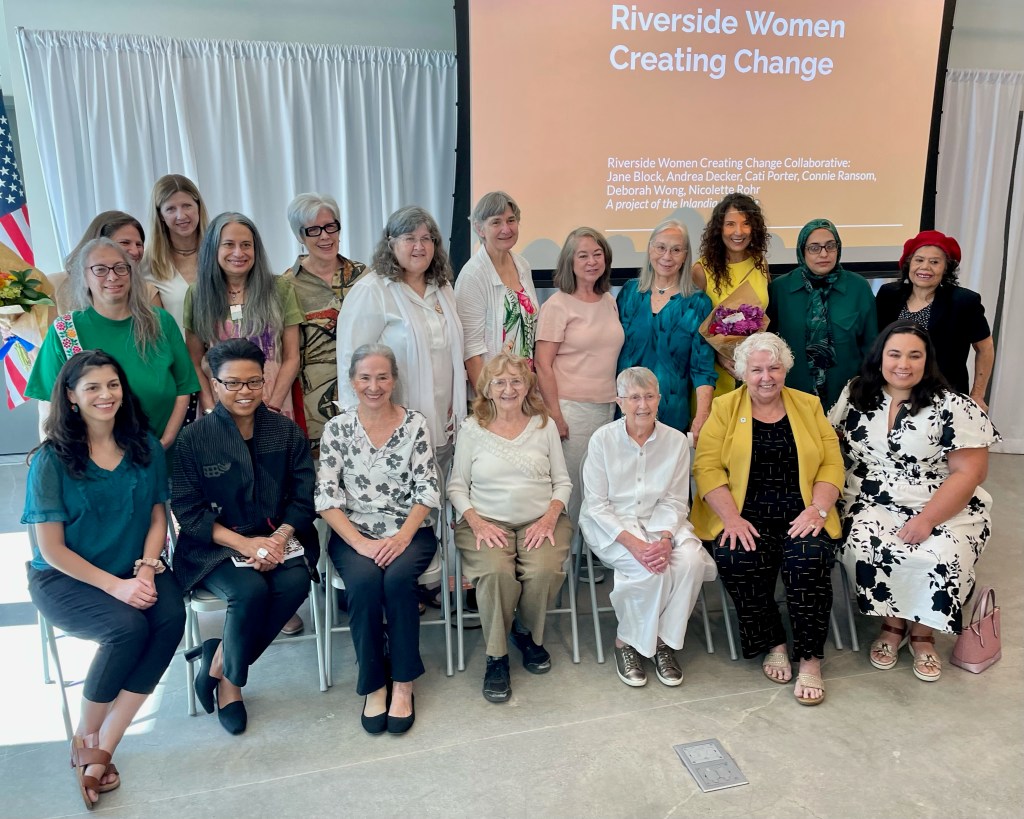
Last Sunday, at the Civil Rights Institute of Inland Southern California, Inlandia launched THE BOOK–a collection of oral history interviews with women of Riverside who’ve made a difference in our community. We can start by saying there will always be more: future organizers and activists, and also past who we did not have the opportunity to interview. This is a living project and we hope that over time to add to it. We know the ancestors list will grow, as it did while we were in the process of completing these interviews.
About half of the interviewees from the book came to the launch, and still that’s only a portion of the overall number of interviewees. How did we make decisions about who to include? What was the process like? Many of those questions are answered in the introduction. I am including it below because it gives a thorough overview of the project.
Highlights from the launch:
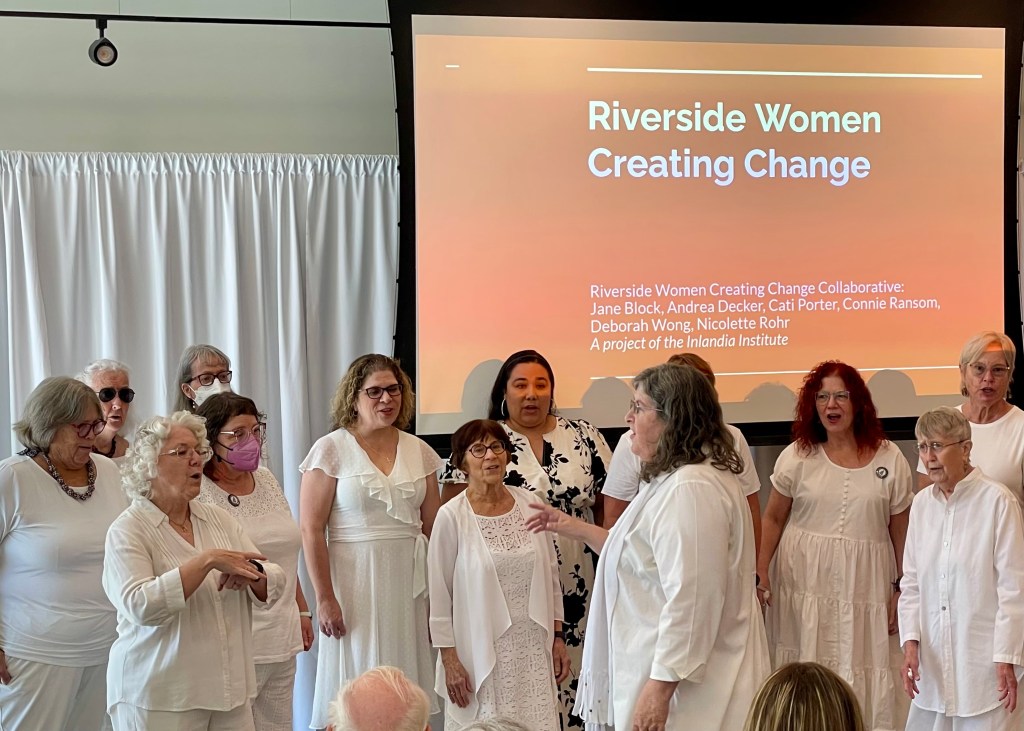
Riverside Resistance Revival Chorus inspired us with song:
Deborah Wong led us in a participatory exchange with someone in the room we didn’t know.
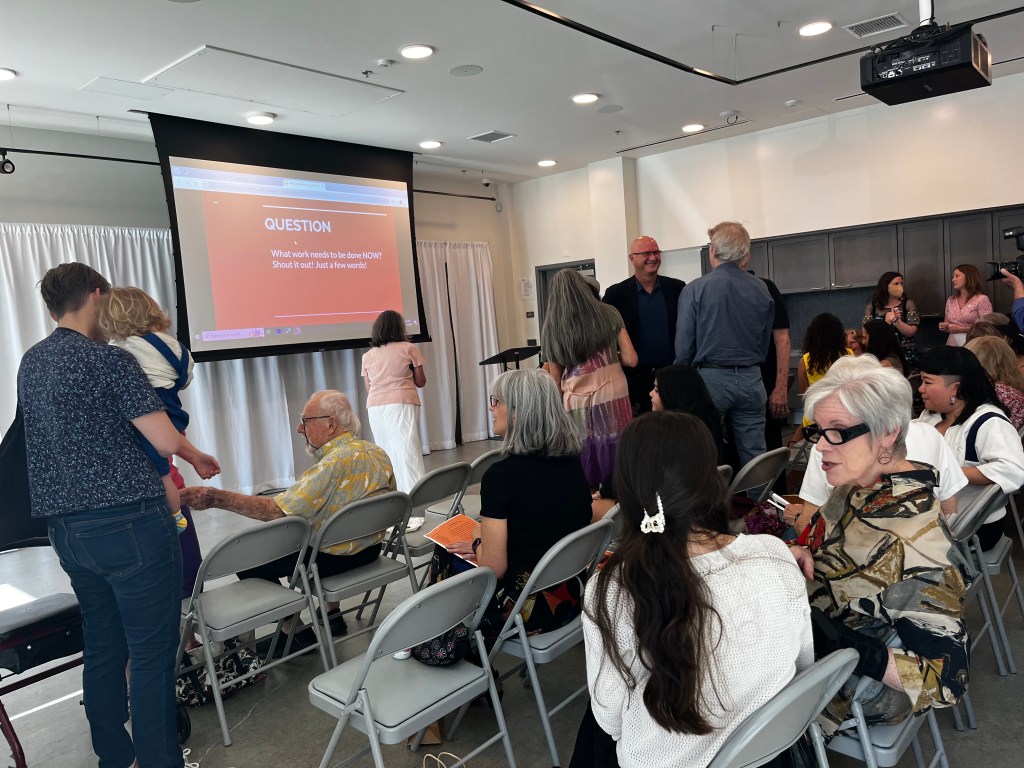
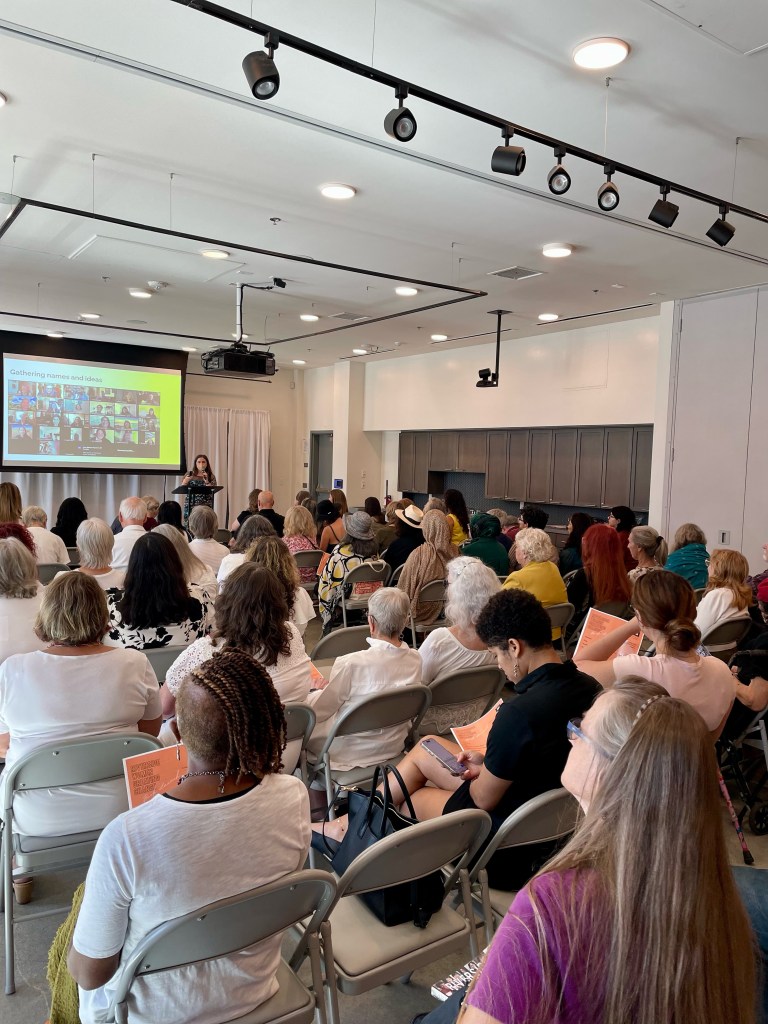
We had a full house! More than eighty people attended the launch, but the star of the show, Jane Block, was nowhere to be found. Ultimately, she did arrive via a good samaritan who found her and brought her to CRIISC. Jane had taken a fall near she believed the event was taking place and needed medical attention. Fortunately, after scans and x-rays and some stitches, she was released, and in characteristic Jane fashion she was cheerful at every turn. It was not quite what we expected but we are all relieved that she is okay.
And now, for the introduction, which was drafted by Nicolette Rohr who served as editor for book. Nicolette took twenty-five page interviews and transformed them into digestible bites. She altered no words, but she did edit out the ums and uhs and trimmed the content down into a form reproducible in a book. The full interviews will be made available to all via Calisphere and through the City of Riverside’s local history archives. We will also be making available an open access PDF through this site. Stay tuned!
Many thanks to all who have supported this project in your own way.
Introduction
Like many other projects in Riverside, this book was Jane Block’s idea. Jane envisioned a kind of “how-to” manual for would-be women-identifying activists. Here, you will find stories of exceptional women who have contributed to the Riverside community alongside examples of what they have done and some practical, useful ideas and advice to inspire you to make your own contributions—excerpted from interviews with the activists themselves.
Jane first shared her idea with Connie Ransom. Connie talked to Cati Porter, Executive Director of the Inlandia Institute, as well as Catherine Gudis and Christine Gailey from UC Riverside, who, along with Paulette Brown-Hinds of Black Voice News, attended early meetings and affirmed this idea with their interest in collecting and sharing stories of Riverside women. Cati invited Nicolette Rohr, a historian who had worked with Inlandia on another story of Riverside women. Then someone had the brilliant idea to invite Deborah Wong, professor of ethnomusicology at UCR, who moved the project forward with enthusiasm and led us to Andrea Decker, who transcribed the interviews and offered valuable insights. Catherine Gudis introduced us to Katherinne Reinoza-Zaldana, an undergraduate at UCR, who contributed to the transcription as part of their studies. Kris Lovekin helped gather materials. We – Jane, Connie, Cati, Deborah, Nicolette, Andrea – became the working group, which we called “Riverside Women Creating Change,” meeting regularly. Our model is one of collaboration, sharing the labor, with each of us taking on different roles to make something out of this idea.
Our earliest meetings were at Jammin’ Bread, Cellar Door Books, or Simple Simon’s, all iconic Riverside spots that have been incubators for change. We thought out loud, listened, and made lists of women we might interview. We talked about how a book might look. Then, shortly after meeting on March 13, 2020, everything changed. The pandemic began, and we moved our meetings to Zoom. Our conversations started to include finding toilet paper, shopping for groceries, wearing masks, supporting our treasured local businesses, and the new routines of our pandemic lives.
In the midst of it, we dove in. Together, we interviewed Jane and Connie. By now, we all knew each other but learned so much more from asking questions and listening. Who to interview next? We put out a call on Facebook and created an online form for recommendations of women to interview. Cati introduced our project to readers of The Press-Enterprise in Inlandia’s weekly column. We gathered more local women – still on Zoom! – to tell them about the project and collect ideas. Deborah and Nicolette started interviewing. Our Zoom interviews – although missing some of the comfort and connection of being in person – proved easy to record and were welcome hours in the isolation of the pandemic. What a gift to talk with so many remarkable women!
The “Riverside women” included in this book were interviewed in 2020 and 2021, and a few in 2022. We know they have many peers and that we all have many ancestors.
Riverside sits on Cahuilla, Tongva, Serrano, and Luiseño land, Indigenous peoples who first called this place home. In the time of the Californios, the women of Agua Mansa, whose descendants we interviewed for this project, made homes on this land. Some of them, like Mercedes Alvarado Jensen, left traces we still see today. Later in the nineteenth century, English immigrants sought to establish a colony on this land. Eliza Tibbets is well known in the city of Riverside’s founding story for planting the parent navel orange tree that helped birth the citrus industry, as well as being an advocate for women’s suffrage and abolition. Immigrants from China, Japan, Korea, Mexico, and elsewhere picked and packed the citrus that made Riverside flourish. Alice Miller Richardson of Riverside’s Mission Inn contributed to Riverside’s growth through her hospitality. Women’s labor was essential to both the Inn and to the citrus groves, and women built community – this community – in the neighborhoods, churches, and schools that became part of Riverside. When the predominantly Mexican American neighborhood of Casa Blanca petitioned for a neighborhood school, it was two women who walked miles across town to successfully present their argument to the school board. Those women, known then only as Las Adelitas but now identified as Ysabel S. Olvera and her comadre Margarita Salcedo Solorio, are our ancestors. In the 1960s, when many of the stories in this book begin, Sue Strickland and Woodie Rucker-Hughes were part of the integration of Riverside schools and pillars of the community for many years. Ruth Anderson Wilson, Martha McClean, and Kay Black founded the Tri-County Conservation League in 1966 and worked to save the Santa Ana River. Beverly Wingate Maloof helped save the Mission Inn and Heritage House and organized Riverside’s inventory of historic homes. Mothers of Jurupa Valley, then part of Riverside, fought tirelessly to raise awareness about the Stringfellow Acid Pits and the harm done to their families, laying a strong foundation for environmental justice organizing.
Oral interviews are at the core of this project, therefore this book features only women we were able to interview, but we acknowledge our ancestors in telling the history of women in organizing in Riverside.
Some of these ancestors are acknowledged at the beginning of the book. Many of their names – Sumi Harada, Woodie Rucker-Hughes, Kay Smith, Mary Lou Morales – are brought up in these interviews. Ruth Anderson Wilson and Sue Strickland died while we were working on this project. We had the privilege of interviewing Nancy Takano, Jennifer Vaughn-Blakely, and Ofelia Valdez-Yeager before they joined the ancestors. Their passing affirmed the need to keep collecting and sharing stories.
There are, of course, many women we did not interview for a range of reasons, not least of them time. There are those we tried to contact but never reached or who declined to be interviewed. There are also some who were interviewed for this project but whose interviews are not included here due to space constraints and other considerations. Their interviews, along with the full transcripts of those excerpted in this book, will find their home in the local history archives at the Riverside Public Library and throughout California on Calisphere and will, hopefully, provide both information and inspiration for researchers and Riversiders of the future, and others who may wish to use this project as a model and blueprint for their own like-minded projects.
We knew from the beginning we could not interview all of the women creating change in this community. The women we interviewed represent a range of ages, interests, and involvement. The oldest was in her early nineties at the time of the interview, and the youngest was in her early twenties. Many were born in Riverside, and many were not. Some had spouses and partners, some did not. Some did not have children, and of those who did, only some had access to child care. Noticing this, some of these women worked to expand child care resources. Some of them were drawn to activism early in their lives, and others much later. Some women had ready access to funding, while others encountered more material barriers. Some own or owned businesses, some were or are educators, many worked in both blue-collar and white-collar sectors, some never worked, and nearly all volunteered their time. Some have served in elected office, some have worked to elect others, and many have fought with or beside elected officials at one time or another. All contributed to the making of this community. Some are also connected to national movements and campaigns.
Many of the women interviewed were reluctant to call themselves activists. We chose to conceive of activism and organizing broadly and include a range of experiences. All of these women share commitments to social justice and community – whether through equality, the environment, cultural heritage, historic preservation, the arts, education, or any number of other causes.
“Community” has been central to each part of this project.
The influence, inspiration, and support of others are clear in each interview. “No one does anything alone,” Jane often says. Pride and appreciation for this community are clear as well. In many ways, these interviews are in community—they give us glimpses into how women navigated their lives and their lives in Riverside, the barriers they faced, and the issues that activated them. They remind us that people build and experience community differently. The interviews offer different advice about attitudes, approaches, and outcomes. The experiences often reflect varying access to resources and ideas about money. We are mindful of the role of privilege and the real barriers many women face. We present these interviews with attention to these distinctions and a belief that recognizing them helps contribute to understanding in and of our community.
We hope, therefore, that along with the stories of these individual women and the advice and inspiration they offer, this book also helps tell stories of Riverside, especially those individual stories that are in danger of being forgotten or may not have yet been told or told often enough. At its core, this is a local history – it takes place on the Eastside and in the Wood Streets; at UC Riverside and Riverside City College; the Riverside Art Museum and the Mission Inn; First Congregational Church and Temple Beth El; and often at Simple Simon’s and Zacatecas.
These interviews also document the histories of national and global events and movements as they looked here: consciousness-raising, conservation, domestic violence, gun violence, police violence, police reform, marriage equality, Black Lives Matter, the Women’s March, the March for Our Lives. Hopefully, some of these stories offer a glimpse of how these movements looked in Riverside. Memories of Bobby Kennedy and Cesar Chavez visiting the Eastside. Jesse Jackson and Al Sharpton marching with the people of Riverside following the murder of Tyisha Miller. Nancy Takano chatting with Nancy Pelosi. These are all reminders of the connections between the local and far beyond.
This book includes a timeline that is also available on the website of the Inlandia Institute and can be used in classrooms, along with excerpts of the interviews themselves. The website also includes a map of places named for women in Riverside – there are not many, but we are hopeful there will be more to come.
Part of Jane’s original idea was to offer advice for others, both practical ideas and philosophical inspiration. We are well aware that there are more stories to tell. The partial nature of our knowledge underscores the importance of these interviews and the need to listen. Here, in profiles of these women, snapshots of this community, stories amount to wisdom. We hope they offer an appreciation for the work that has been done and inspiration for the work ahead.
Riverside Women Creating Change collaborative

 Riverside Women Creating Change